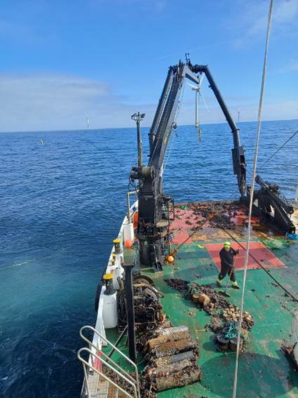
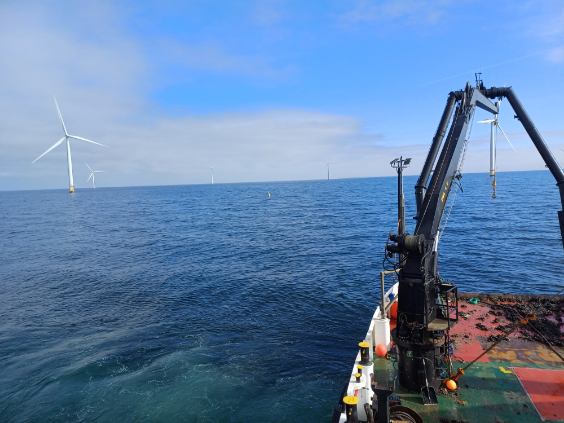
The Anholt test site was set up to investigate whether commercially viable mussel cultivation could be integrated into one of the Baltic Sea’s largest offshore wind areas. After a couple of years of testing production potential and monitoring systems in open-sea conditions, the project has officially wrapped up at sea, marking a key milestone on the road to understanding what offshore mussel farming can achieve. The operation took place between March 14 and 16, after careful coordination to secure both an Ørsted approved vessel and a suitable break in the weather.
Strong Seas: Challenges Of A Final Retrieval
The decommissioning presented a few challenges from the outset. Strong currents made anchor retrieval unexpectedly demanding, requiring considerable time and ship engine power to pull up the corner markers. Additionally, the farm structure itself had partially collapsed prior to the team’s arrival on site. Despite this hurdle, the team was still able to locate the buoys using echo-sounding equipment, which then guided the recovery of the long lines.
An encouraging finding:
Even with the structural damage sustained, there were still plenty of live mussels on parts of the long lines. However, since the mussels were positioned just above the seabed, it wasn’t possible to draw firm conclusions about their growth potential under normal operating conditions. Most of the monitoring equipment was successfully recovered, and the team is currently working on extracting data from the loggers. As the team shifts its attention to the data, the findings from Anholt will help shape the next steps for offshore aquaculture in the region.