ULTFARMS is pleased to share an important milestone from our partner F&E GmbH. The team has successfully upscaled the nearshore macroalgae cultivation system in Kiel Harbour, significantly expanding the capacity for controlled field testing of sustainable low-trophic aquaculture in coastal conditions. This work adds an essential nearshore comparison point to the offshore pilots operating in the North and Baltic Seas.
Upscaling the seaweed system in Kiel
Working closely with our project partner Hortimare, and with active support from pupils and teachers of the Lernwerft “Club of Rome” school, the team deployed the first 760 metres of seeded longlines. All lines were seeded using local sugar kelp (Saccharina latissima) seedstock collected in proximity to the cultivation area to maintain genetic and ecological compatibility with the native environment. The system will be extended in December to a total of approximately 1.5 kilometres of cultivation lines, enabling production of substantially greater biomass while allowing performance evaluation at a relevant pre-commercial scale.
Why sugar kelp matters for low-trophic aquaculture
Sugar kelp is one of the most promising species for low-trophic marine production systems. As a primary producer, it grows using only sunlight and dissolved nutrients, without requiring freshwater, fertilisers or feed. In addition to offering a sustainable biomass and potential protein source, it contributes significantly to ecosystem functions. Sugar kelp beds provide habitat and feeding structures for associated species, and they bind nitrogen and phosphorus. This nutrient uptake is particularly important in the Baltic Sea where eutrophication remains a major environmental challenge.
Testing multi-use in nearshore conditions
Due to the limited availability of marine space, the ability to integrate multiple uses into the same location is increasingly important. ULTFARMS investigates multi-use both offshore in wind farms and in sheltered nearshore areas such as ports. The Kiel Harbour installation provides an ideal setting for testing system behaviour under calm but variable hydrodynamic conditions and offers a controlled environment to assess logistics, installation techniques and cultivation performance without the challenges posed by offshore exposure. Combined with offshore results, these data help refine technical design parameters and evaluate the suitability of different production concepts for various environments.
Comparing two leading seeding methods
The Kiel system supports a technical comparison of two widely used, yet fundamentally different, seeding approaches for sugar kelp cultivation.
- Pre-grown hatchery twine.
This method involves cultivating juvenile sporophytes on thin twines under controlled hatchery conditions. Once the young kelp reaches a suitable size, the twine is wound onto the main cultivation rope in the field. This technique provides predictable early-stage development, better control over density, and more uniform attachment. - Direct “binder seeding” using a seeding machine.
In this approach, spores are applied directly onto the cultivation rope using aspecialised machine operated with biodegradable binder. This eliminates the need for intermediate twine substrates, reduces labour-intensive handling steps and may offer cost advantages at larger scales. The ULTFARMS trials in Kiel provide an opportunity to optimise binder viscosity, adhesion properties and spore distribution under real-world winter conditions.
Although temperatures during deployment were below freezing, such conditions are favourable for the early growth phase of brown algae. Sugar kelp exhibits its highest winter growth rates when competitors are minimal, light conditions are stable and biofouling pressure is low. The reduced harbour activity in winter also creates safer operational windows for installation work.


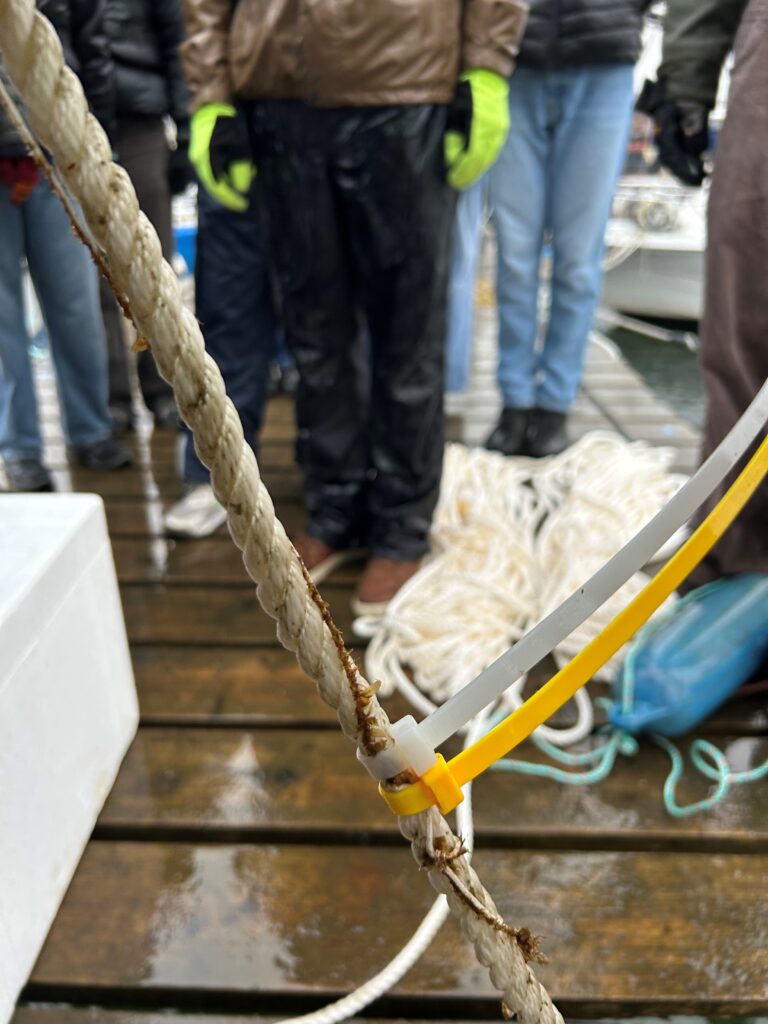
Photos 1, 2, & 3: The F&E GmbH team together with teachers and pupils from the Lernwerft “Club of Rome” school and the ULTFARMS partner Hortimare during operation of the seeding machine.
Over the coming months, the F&E GmbH team will monitor growth, attachment strength, hydrodynamic response of the lines and overall system stability. A full harvest is expected in spring, when the comparative performance of both seeding methods can be quantitatively assessed.

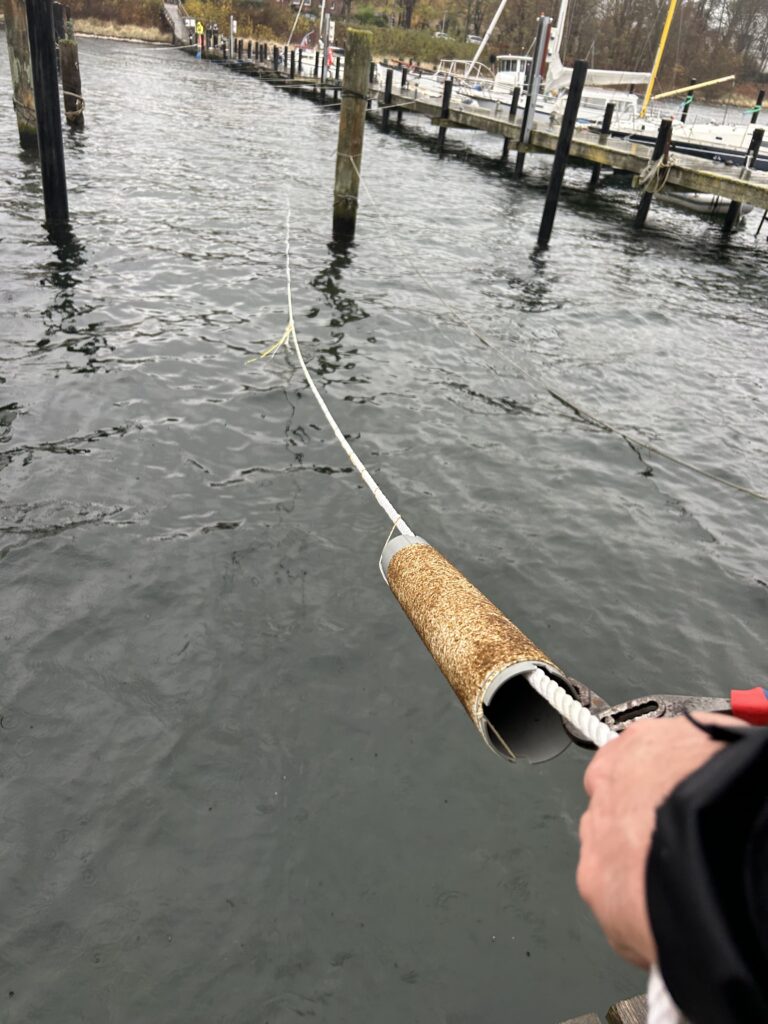
Photos 4 & 5: The first longlines installed, each about 80 to 100 metres long, including sections seeded with pre-cultivated hatchery material.
Building best practices with multi-site field trials
Following the final harvest assessment, results from Kiel will be compared with parallel field trials conducted by Hortimare across multiple European locations. This multi-site approach generates insights into species performance under diverse environmental conditions and helps identify robust cultivation practices. Hortimare’s long-term programme, now in its fifth year, aims to refine technical protocols, validate binder seeding innovations and steadily advance the reliability of sugar kelp seed production and deployment systems.
For ULTFARMS, these findings contribute directly to the development of efficient, scalable low-trophic aquaculture models suited for both nearshore and offshore settings. The work in Kiel supports our broader aim of demonstrating that environmentally responsible, multi-use aquaculture can be integrated into Europe’s future Blue Economy.
We extend our thanks to F&E GmbH, Hortimare and the pupils and teachers of the Lernwerft school for their dedication and collaboration.
